Saturday, August 24, 2013

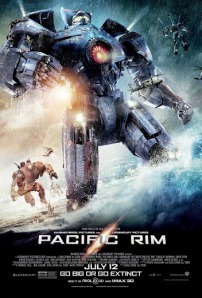
'Pacific Rim' rock-em sock-em robots unconvincingly defeat kaiju

1150530_545254538874181_1393168422_o
Watching "Pacific Rim," I could help but think of the Rock-em Sock-em robots. I know that the movie is targeting a male audience and I'm not a guy. I also know that the writers are trying something new, but that still doesn't make it good, particularly when you consider the
Rockem-Sockem-RobotsGametradition of the creatures called kaiju and Godzilla. 

Godzilla is a kaiju, but not the only kaiju. To be specific, Godzilla is a daikaiju. My trusty Japanese-English Kenkyūsha dictionary defines a kaiju as "monstrous beast" but we can edit that down to monster. Monsters come in all sizes and forms as all Lady Gaga followers know and that is true even for Japan where pocket monsters came from (Pokkemon).

Godzilla doesn't make an appearance in "Pacific Rim," but you can feel his hot atomic breath in its every frame. We could call it Godzilla envy or licensing envy. Without a claim to the kaiju of fame, the writers decide to create their own kaiju. These kaiju are gigantic and we're not sure how they are fed, but they could have Tokyo for lunch with a few buses as appetizers. They have that anthropomorphic form of a man walking in a monster suit, but they move with surprising grace underwater. The animation is of a high level as you'd expect from the director Guillermo del Toro who gave us such wondrous creatures in "Pan's Labyrinth."


So the story, written by Del Toro and Travis Beacham goes like this. Sometime this year, 2013, our cities come under attack by kaiju. These are extraterrestrial beings who usually take the lone-wolf approach to attack. They are based under the Pacific Ocean, arriving through a interdimensional portal. The nations of the Pacific Rim come together to construct the humanoid war machines called Jaegers that require two humans to control inside the detachable head. Despite the coolness of Samsung and Sony cellphones and tablets, Honda's ASIMO and the Toyota Prius, the East Asians aren't really that involved in this production. Why else would these supposedly sophisticated machines get a German name?

Jaeger is a German word and I confess that I never saw the need for studying German. There is still time, indeed, but this movie won't convince you to get out and get more serious than toasting to Octoberfest. Of course, I don't drink so that puts a bit of a damper on the whole we are German for a month thing in the U.S. But the like-em or leave-em sentiments about Germany are of little consequence for "Pacific Rim" because the Germans and German don't have much to do with this film. That makes some sense because Germany is not a Pacific Rim nation.
Pacific-Rim-Movie-Jaeger-Gipsy-Danger1-700x984
What makes less sense is that Japan, the country that supplies us with the term for the alien enemies, only supplies the movie with its female possible love interest. If you're still at the girls got cooties stage of development, then don't worry. The ick-factor of romance, and even the ick-factor of a Madame Butterfly romance is totally absent from this film.
What isn't absent is the concept of White Man's Burden (that's a Rudyard Kipling reference). Yes, white men save the world and its not the reds although I did debate whether the Star Trek TOS red-shirt plan was in effect.

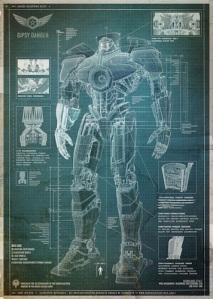
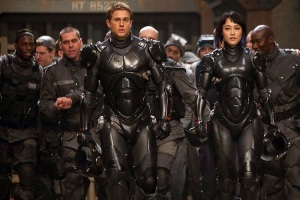
First we must find our white hero. One of the first Jaegers is the Gipsy Danger manned by brothers Raleigh (Charlie Hunnam) and Yancy Beckett (Diego Klattenhoff). These guys are hot shots who don't necessarily listen to their commander. In their last mission, their Jaeger is decapitated and Yancy is killed. Raleigh is able to make it back to Alaska, but retires.  The year is 2020.
Pacific-Rim-movie-review-5

Even in the realm of science, the Pacific Rim countries didn't produce much research on the kaiju. The leading kaiju scientists are these colorful comedians: Dr. Newton Geiszler (Charlie Day) and Dr. Hermann Gottlieb (Burn Gorman). They work alone because they must be underfunded and the script writers know little to nothing about how a science lab works--they don't know that lead scientists have their own drones--slaves working for the betterment of science or a chance at getting their own lab or at an academic level, poor grad students who might not be getting paid. So we have these two white guys on the wrong side of eccentric.

By 2025, the Pacific Rim governments have decided to scrap the Jaeger program in favor of building the Great Wall of the Pacific Rim. How that will work for Japan, Hawaii, the Philippines and New Zealand is never adequate explained, but perhaps those island nations have just been written off as casualties of war. What would be Great about a Great Wall is imagine the future tourists.  Raleigh is one of the men working on the Great Wall of Alaska and he's contacted by the commander of the remaining Jaegers, Stacker Pentecost (Idris Elba).
There just happen to be four Jaegers left, including the seriously outdated Gipsy Danger. Just the number should have given the Chinese and Japanese reason to pray for good luck. If you are replacing your cellphone every two years or trying to keep your computer up-to-date, you know that five years of technology in means that the Gipsy Danger is almost an antique. So the Gipsy Danger is going to be a support team for the much newer Jaegers.

The primo Jaeger, Striker Eureka, is piloted by a father-son team from Australia: Herc Hansen (Max Martini) and Chuck Hansen (Robert Kazinsky). The father respected Raleigh. The son thinks Raleigh is a danger to them all.  Raleigh must also search for a new co-pilot who must be able to drift--share minds in a non-Vulcan mind-meld--together way.

Instead of using something scientific like the Mensan favorite--the Keirsey Temperament personality sorter (ENTJ or INTJ), the Jaeger program uses individual combat which incorporates sticks like kendo and rolling around on matts like some East Asian martial arts. A handful of East Asian guys are easily beaten by our construction worker Raleigh, but the East Asian woman, Mako is his true match.

On a real life level, this might be a product of white male anxiety. Consider the Olympic record of the white American male at the Olympics in judo and the more recent addition of taekwando.

Judo was first included in the 1964 Tokyo Olympics. Japan leads the world in gold medals with 36 (18 silver and 18 bronze); France has 12 gold (8 silver and 24 bronze). South Korea has 11 (8, 24) and China has 8 (3, 9). The U.S. isn't in the top ten with only one gold medal (3, 7).   The American gold medalist was Kayla Harrison at the London Games. The men winning silver were Kevin Asano (1988) , Jason Morris (1992) and Robert Berland (1984).  West German and the United Kingdom have one gold medalist each. Canada has none.

Taekwando has been an Olympic event since 2000. South Korea has 10 golds, China has five and the U.S. has two (like Taipei, Mexico and Iran) won by Steven López in 2000 and 2004 (bronze in 2008).
So maybe, white guys are either delusional or have that Olympic inferiority complex to contend with. In either case, considering how the Jaegers move, the whole combat style test makes no sense.

While the kaiju in the water have fluid movement and zip around like a seal after a sashimi dinner,  the vehicles of kaiju destruction Jaegers trudge around like Godzilla on land and are even more plodding in the water. For the drivers of these machines to enter, the head must come off and the crew must screw it back on after the head is lowered in place. Nothing about these machines is quick or efficient which is why the kaiju should win.
Now if your two drivers are essentially meant to jog in place in synchronization while pushing buttons, the ideal training would be synchronized jogging or synchronized marathon running. 

If your machine works on the concept of the rock-em sock-em robots than maybe studying Muhammed
Ali and learning the fundamentals of boxing would be more practical and logical. Logic is definitely not a problem for this film...after all, the script writers have already posited that scientists are brilliant idiots who can explain but not do.

Our brilliant idiots want to mind-meld or "drift" with the brain of a kaiju and in order to do so more than once, they need to deal with a man in charge of the black market of kaiju parts in Hong Kong. Even in Hong Kong, even after the return of Hong Kong to the mainland Chinese from British rule, the Hong Kong black market is ruled by a white guy, Hannibal Chau (Ron Perlman) who has a bunch of East Asian flunkies to help him sell kaiju parts. I guess the tongs have been rendered powerless in China.

Hannibal Chau gets his name from his favorite historical figure and his favorite Szechuan restaurant. Woo-hoo. Chinese food keeps up its rep, but Chinese aren't clever enough to do more than cook, even in China. Chau helps our mad scientists and the scientists get intelligence from the kaiju which helps our Jaeger team.
photo
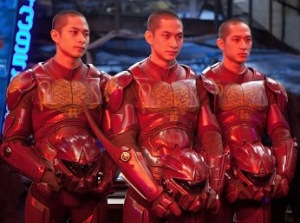
There is a Jaeger manned by Chinese Wei triplets (Charles Luu, Lance Luu and Mark Luu ) but they are just like politically correct filler. The Russian team of  Aleksis and Sasha Kaidanovsky (Robert Maillet and Heather Doerksen) get more screen time but both the Chinese and the Russian Jaegers are soon eliminated which brings up the TOS Star Trek red-shirt debate. The Aussie Jaeger will have a good go at it (with an injured Herc replaced by Stacker) but you know that Raleigh with the help of Mako and Mako helped by Raleigh will triumph.

The solution involves detonating a nuclear weapon at the underwater portal. Did the writers forget that is how the most famous kaiju was created? This is perhaps the most striking consideration for kaiju fans. The original Godzilla movie was seen as a protest against nuclear testing in the Bikini islands, coming out the same year that the crew members of the tuna fishing ship Lucky Dragon 5 were exposed to radiation. Daigo Fukuryū Maru (第五福竜丸) was not in the zone where the U.S. have designated as a test zone. The Castle Bravo thermonuclear device was twice as powerful as the scientific data had predicted. On March 1, 1954, the wind carried ash and radiation to where the ship was stationed and of the 23 fishermen, 11 died of radiation poisoning.  The Daigo Fukuryū Maru is currently on display in Tokyo.  The 1954 incident was a catalyst for the Japanese anti-nuclear movement.

The Fukushima Daiichi nuclear disaster has brought renewed public interest in the trawler and Fukushima brings up another concern--tsunami. Would a nuclear detonation cause a tsunami that would effect those insignificant islands such as Japan, New Zealand and the Philippines who were likely not protected by a wall? I don't believe that the Latin American countries on the Pacific Rim are represented at all.

No commentary on the whitewashing would be complete without mentioning that the Chinese American technician who is supposed to be the brain behind the Jaegers is played by Clifton Collins Jr. The Los Angeles-born Collins who plays Tendo Choi is of German and Mexican descent. Does he pass for you as Chinese?
I suppose that the Japanese were probably battling their own kaiju such as Godzilla and couldn't take a time out for these new kaiju. The absence of Japan and Honda's ASIMO technology might explain why the Jaeger are as heavy-footed as the 1905s Godzilla and not as quiet as ASIMO.  I suppose every Godzilla film needs a Raymond Burr to explain things and help save the Japanese. I suppose a lot of things haven't changed since the 1950s when Godzilla first came out.

I do wonder if the kaiju are too busy monologuing to have a full force attack on the people above ground. But I also wonder who fabulous a Chow Yun-Fat or Tony Leung might have been as Hannibal Chau. So many actors could have been Tendo Choi. You think there must be some actors in the Pacific Rim that could have made the time and been up to the relatively undemanding acting levels required here.

Even if you forgive the white man saves the world theme and the whitewashing, the Jaegers are too slow and clunky (but make a great action figure toy) to claim victory over the kaiju. "Pacific Rim"  lacks logic within its own universe and the acting is as plodding as the rock-em sock-em robots. Will the kaiju mutate and come back as Godzilla's lesser known irradiated cousins?  Only time will tell since this movie has been highly successful worldwide. I'm waiting for Mattel to produce the rock-em sock-em robots Pacific Rim Jaeger edition. A good idea that someone should jump on before Christmas (although "Pacific Rim" hasn't been doing well in Japan). 

Wednesday, June 19, 2013

'The Good, the Bad, the Weird': High style and humor in Korean treasure-map 'Western'

Sometimes the kind of movies we see depend upon our expectations: We get to see whatever serves the stereotypes we have. If you've been thinking that Korea just has those K-pop idol vehicles, soft romantic chick flicks that are far from chic and the whore and gore stuff, then you've missed the real genre flipping fun that is the 2008 "The Good, the Bad, the Weird." The movie is currently available for instant streaming on Netflix.


This guksu gunslinging Western is all that the movie "Wild Wild West" should have been. Directed and written by Kim Ji-woon (with Choi Jae-won), "The Good, the Bad, the Weird," is an homage to the 1966 Sergio Leone Italian spaghetti Western, "The Good, the Bad and the Ugly."

"The Good, the Bad and the Ugly" starred Clint Eastwood as "The Good" with Lee Van Cleef as "The Bad" and Eli Wallach as "The Ugly." That movie was set during the American Civil War (1986-1865), but the characters aren't really involved in the war. A bandit, Tuco Ramirez (Wallach), is captured by a bounty hunter, the unnamed "Blondie" (Eastwood). Blondie turns Tuco in, but saves him from behind hanged after he collects the reward money. This unlikely partnership breaks down with Blondie deserting Tuco in the desert. Tuco hunts Blondie down and then forces him to march across the desert. During this journey, Tuco finds a carriage with the dying Bill Carson who is babbling about Confederate gold buried in a graveyard. Tuco leaves to get water, but returns to find Carson dead, but Blondie has heard Carson's secret.

Dressed as Confederate soldiers, Tuco and Blondie are captured by Union soldiers and put in a POW camp. Angel Eyes (Van Cleef) knows about the gold and tortures Tuco to get the information. Angel Eyes then forms a partnership with Blondie. Like social quicksand, the partnerships shift and change as the three men go after the gold until their famous Mexican standoff.

Leone was criticized for the film's violence, but by exaggerating the violence Leone  pushed the film toward a cartoonish reality and brought a "tongue-in-cheek" satire to the Western genre.

Kim Ji-woon transports the action to the 1930s, so we have better weapons and the confusion of the Japanese invading China (Manchuria) and Korea. Yet the Japanese Imperial Army are minor players in this story which insinuates that the best fighters weren't in the army...they were bandits. Kim gives us gorgeous blue skies with picturesque clouds and wide open spaces of the frontier of Korea and China. As another nod to Leone's movie, the musical score swells with dramatic movement mixing Spanish and Asian influences. Ennio Morricone fans won't be disappointed although the heavy musical tie-in isn't consistent throughout.

The Bad (Lee Byung-hun) is hired to steal back a treasure map from a Japanese official. We know from history that the Japanese army are the bad guys so we should be okay with this double cross. Dressed in black, The Bad is the one with fashion sense, forced to glower through locks of hair that obscure a third of his face.

The Weird (Song Kang-ho) brings comic relief and crosses paths with The Bad during a train robbery. The Bad has come to reclaim the treasure map, but The Weird takes off with it. The Good (Jung Woo-sung), a bounty hunter in a long tan dress coat, also turns up, seeking the bounty of The Bad's head. The Weird also has a price on his head, becoming a bonus.

The Weird flees with The Good and The Bad is in hot pursuit. Joining them is the Japanese Army; the map is vital to saving the Japanese empire. Along they way to the treasure, with the advances in weaponry in the 1930s versus the 1860s, opportunities for bigger, better, badder booms and blasts abound. There will be a Mexican standoff and they will find the treasure, but not everyone will have a happy ending.

This guksu gunplay movie is great fun, with a graphic flair aided by CGI. Kim's movie isn't a slavish homage to the Leone films. It has more intensely choreographed fights scenes and a wicked humor accompanied by a firm fashion sense. "The Good, The Bad and The Weird" screened at the Cannes Film Festival in 2008 (out of competition). The movie was given a limited release in 2010.

Jung Woo-sung (The Good) won a Best Supporting Actor award at the 2009 Asian Film Awards. Kim Ji-Woon took Best Director at the 2008 Sitges Film Festival and the 2008 Blue Dragon Film Awards.  The film also received awards for cinematography (Lee Mogae). In Korea, Mandarin and Japanese with English subtitles.


Thursday, June 13, 2013

'The Great Magician' introduces an amusing romantic triangle

An ice queen dressed in white with a severe set of bangs, a magician who has returned to China after the fall of the Qing Dynasty mixing Western and Eastern magical skills and a big bully who remains fascinated with prestidigitation come together for this amusing period piece, "The Great Magician," currently streaming on Netflix.


To put this in a historical perspective, the Qing Dynasty began in 1644 and was the last imperioal dynasty for China. China's power was undermined by wars with European nations and those infamous unequal treaties that Western nations such as the U.K, the U.S., France, Sweden, Norway, Russia, Prussia, Germany, Portugal, Spain, Italy, Austria, Hungary, Belgium and the Netherlands. The first of the unequal treaties for China was the 1842 Treaty of Nanjing with the British Empire. The 1901 Boxer Protocol would add an Asian nation to this exclusive club and the U.K. would add the 1914 Smila Accord and a year later the Empire of Japan would have the Twenty-One Demands and then the 1933 Tanggu Truce.

Japan's first unequal treaties would be signed in 1854 with the U.S. (Convention of Kanagawa) and the U.K. (Anglo-Japanese Friendship Treaty). Japan would be first in line for an eneuql treaty with Korea (Japan-Korea Treaty of 1876). The U.S. and the Qing Dynasty would also impose an unequal treaty in 1882. Japan and China would be the only Asian nations to impose unequal treaties.

The Qing Dynasty ended with the ouster of the Empress Dowager Longyu and the last emperor Puyi. Puyi would be briefly restored to the throne in 1917 by the Chinese warlord Zhang Xun, but that would last less than a month. Puyi would be expelled from the Forbidden City in 1924. In 1932, he'd become the ruler of Manchuria under the support of the Imperial Japanese Army.

The 2011 movie "The Great Magician" (大魔术师traditional Chinese大魔術師) takes place during that time of chaos between the fall of the Qing Dynasty when the Western nations had imposed the unequal treaties and China was reduced to squabbling warlords attempting to enlarge their own fiefdoms. There is a looming Japanese presence (Kenya Sawada), but the invasion hasn't yet been fully realized

If you're wondering how the warlords got their hordes, according to Derek Yee, Chun Tin-nam and Lau Ho-leung's script, a little fear and a bit of magic never hurt. Liu Kun Shan (Wu Gang) performs a frightening bit of magic that convinces a large group of men to join the forces of warlord Lei Bully (Lau Ching-wan). Bully has several wives, six to be exact, and hopes to add a seventh.

Wife seven, Liu Yin (Zhou Xun) resists Bully who has threatened her father. Her fiancé had disappeared during his journey to Europe. Yet now he has returned as a magician, Chang Hsien (Tony Leung Chiu-Wai) who is working with revolutionaries who want to use the magic show to kidnap Bully.

This production is richly realized with detailed backgrounds and costumes. There is no real enemy and neither Bully or Chang Hsien are political animals. Both entranced by the pale and unyielding Liu Yin, they are bound together in a comedic triangle.

Director Derek Lee, gives us both magic that crosses over into fantasy (with just enough CGI) and a light-hearted rivalry that ends with a question mark and hopefully more adventures to follow. The movie won a 2013 Hong Kong Film Award for Best Costume and Make up Design (Jessie Dai and Chung Man Yee).  In Mandarin with English subtitles, "The Great Magician" is available on Netflix for instant streaming.

Wednesday, June 12, 2013

'City of Life and Death' sheds light on the gray areas of war

The 2009 Chinese historical drama has a poetic English name, "City of Life and Death," but a repetitive Chinese name "Nanking! Nanking!" (or "Nanjing! Nanjing!") Either way, this movie which was written and directed by Lu Chuan attempts to shed light on the gray areas of war by looking at the lives of several people in the city of Nanjing when it fell to the Japanese Imperial Forces in 1937.
Filmed in black and white, the city of Nanjing has just been captured by the Japanese Imperial Army. We learn before the movie really begins at the camera shows us old postcards with dire short messages. From there, we are introduced to a Japanese soldier, Kadokawa Masao (Nakaisumi Hideo), who has been lying on his back looking at the sun. He joins other soldiers in a foxhole before a burning city. Tanks are moving toward the city's walls as the men wait.

Another postcard tells us that the Chinese National Revolutionary Army is in chaos. We are in the city and soldiers line up. Along with them are the city residents. Chinese soldiers want to leave the city, but their fellow Chinese soldiers attempt to prevent them from exiting. Here we meet Lieutenant Lu Jianxiong (Liu Ye) and Shunzi (Zhao Yisui) who attempt to convince some of their comrades to stay and defend the city. With the black and white format, it's not easy to differentiate the two sides and the horror of the bloodshed, burned bodies and mutilation is muted. We don't see the beauty of flight as in the strangely dream-like desperation of the girls at the beginning of "Flowers of War," and instead we see dust and confusion in the ruins of a city.

Much of the aftermath is from Kadokawa's perspective. He watches men being killed on the streets, women being led away. He sees corpses--some whole but not untouched as the naked woman and some mutilated. Heads hang like macabre celebratory decorations from the ruins. And yet those still living stand like a grain field. Leaving Kadokawa, we see things from an overhead view. From some vantage points, the people fill the streets in a seemingly unending fields of humanity. It is at this point we understand just how few men are in this victorious army. As the Japanese mow down people running into the sea, use them for bayonet practice, bury them alive or burn alive in a building set on fire, the military necessity of the actions is hinted at. What if, each Chinese person had been willing to sacrifice for the greater good?

With the men and soldiers defeated, the international witnesses who remain in Nanking such as John Rabe (John Paisley), Minnie Vautrin (Beverly Peckous)  and Durdin (Sam Voutas) set up a safety area where people seek refuge, food, water.  By safe, that's a matter of relativity and some of the people there include wounded soldiers. Japanese soldiers periodically intrude; they harass and assault the refugees, especially the women. The daughter of Rabe's secretary, Tang Tianxiang (Fan Wei) is thrown out the window to her death and his sister-in-law is raped (Yao Di). The Japanese demand 100 comfort women.

The camera shake, quick cuts and at times blurred motion produces a feeling of chaos. A whole range of human feeling is portrayed and unlike "Flowers of War" the rapes do not have a voyeuristic quality. The so-called good Nazi, John Rabe is shown protesting the brutality and regretfully finally leaving China, unable to take all the Chinese people he had known and worked with.

Not all the Japanese soldiers feel the weight of their horrific actions. Yet we see how the attitudes of the soldiers toward the Chinese women also carries over to their own women or perhaps it is the other way around. Kadokawa slowly becomes desensitized to the violence but recognizing the same dull resignation in the eyes of a Japanese woman that he has seen in the Chinese breaks the protective shell he has built.

"Life is more difficult than death," Kadokawa tells another Japanese soldier after he has allowed to Chinese prisoners to escape. In the end, photographs tell us the fate of each character by their name and their lifespan.

Although this film has been criticized for its sympathetic portrayal of a Japanese soldier in Kadokawa, the film gives a more balanced view of the Rape of Nanking and clearly shows the brutality of war and the heavy price both sides pay.

"City of Life and Death" is currently available on Netflix for instant streaming.


Sunday, June 9, 2013

'White Frog' limp look at Asian American boy with Asperger's


 There are so many things one wants to say, but cultural norms dictate we don't. With Asian Americans, as both a minority and the "victims" of cultures that value humility, we seem to have even more things that we cannot say...except, perhaps, if one has Asperger's Syndrome. Our main character in "White Frog" is Asian American with Asperger's. He goes from being a double A to a triple A, but that doesn't mean this movie deserves an A plus.

Yes, it is wonderful that the movie shows Asian Americans as an average family dealing with average issues, and it's nice to see Asian Americans playing Asian Americans, but there are just too many issues to deal with. Besides Asberger's, there's how three family members deal with death, community involvement (save the community center), in the closet gay youths and faith against tolerance. I don't mean to say that those who are truly faithful aren't tolerant or that people without religious faith are necessarily intolerant.

Fans of BD Wong and Harry Shum Jr. will be disappointed. We don't see either of those men nearly enough. Shum plays the "perfect" son Chaz of Oliver (Wong) and Irene Young (Joan Chen). Nick is the kid with Asperger's. His parents do all the right things. They provide him with therapy (Amy Hill as Dr. King).

Written by mother and daughter duo Fabienne and Ellie Wen, you wonder if there are just too many cooks in the kitchen and not enough critical conversations. One doesn't for a moment doubt that all involved have the best intentions, but with so many different issues, none of them receive enough attention to give this movie direction. Quentin Lee directs.

Fanning the flames of hate with 'The Flowers of War'

The 2011 Chinese movie "The Flowers of War" (金陵十三釵) is a historical war drama directed by Zhang Yimou. In my original essay, "'The Flowers of War' has overpowering scent of nationalism" (also published on Examiner.com) I panned the movie saying:

Have no doubt. Director Zhang Yimou's "The Flowers of War" is a propaganda movie where the Chinese are all heroic and the Japanese invaders are all despicable. We've seen this kind of war movie before, but haven't audiences matured beyond the black and white stark morality?
The LA Times reviewer wrote "Zhang Yimou’s 19th feature is decidedly backward-looking: A lavish period weepie set against the atrocities of the Nanking Massacre, “Flowers” abounds with well-worn movie archetypes and slathers on schmaltz." and then added:


But however terrible and real the threat of rape, the clumsy screenplay turns every Japanese soldier into a rampaging maniac, some of them screaming exultantly upon discovering virgins. The exception is commander Hasegawa (Atsuro Watabe), a soft-spoken man who appreciates music. The genteel colonel isn’t, however, above arranging for the convent girls to be delivered into the hands of his superiors, setting in motion a contrived series of climactic events that are nonetheless affecting because of their elemental power.
 The Hollywood Reporter reviewer agreed writing, “If Warner Bros. had made a film with this plot back in 1942, it would have made effective anti-Japanese propaganda and probably absorbing drama in the bargain. Today it just plays like hokum.”

"The Flowers of War" was based on the novel "13 Flowers of Nanjing" by Geling Yan. The movie was the official Chinese selection for the Best Foreign-Language Film for the 84th Academy Awards and it didn't make the short list. It was, however, nominated for the Golden Globe Awards. 

The story begins in 1937 as the Japanese Imperial Army marches into Nanjing and begins the massacre. Girls run back to their school, a Roman Catholic cathedral. An American mortician, John Miller (Christian Bale) joins them, but he's there to ready the priest for burial. In time, Miller and the girls are joined by prostitutes who hide in a cellar. 

A Japanese officer (Atsuro Watabe) places guards outside the gates and assures the school girls will be protected. Yet he is overruled later when his commanding officers send an invitation to the school girls to come and sing at a victory celebration.  The prostitutes and the only boy in the mission agree to disguise themselves as school girls and sacrifice themselves: They are the 13 flowers . 

Miller leaves with the girls hidden in a truck, supposedly to freedom. That might seem like a happy ending, but we know that Christians and people with Western education weren't treated kindly under the Communist rule that followed the end of World War II. It's something like having the real-life Maria von Trapp and the Trapp Family singers escape into France or the story of the M.S. St. Louis. 

My last review attempted to give readers a historical perspective but mostly bought out comments by hysterical pro-Chinese respondents. I then did research and found, not surprisingly, that other critics found the movie problematic for the same reasons, however, those people weren't identified as Japanese and I've found that sometimes being critical of a Korean movie or person or a Chinese movie or person can bring out the biases. I don't think that I'm prejudiced so much as the writers revealed their prejudices.


The movie was based on a novel by Geling Yan, "13 Flowers of Nanjing," (金陵十三釵)  or Gold Tomb (Mausoleum) 13 Hairpins or 13 Girls of Jinling. Consider that Google Translate gives Mausoleum of War for 陵十三釵.  I can't comment on the book because I haven't read it. The screenplay is by Liu Heng. 

The movie was the top grossing Chinese film in 2011. While director Zhang Yimou has stated that the movie is about love and sacrifice, there's an uneasy undercurrent of sexism. Outside, where danger lurks, the world is cast in muted tones. Yet cinematographer Zhao Xiaoding makes the inner sanctuary where the prostitutes hide a place of saturated colors and glamour. The institute of prostitution under the Chinese is seen as less brutal than the rampage of the Japanese, setting up the old concept of war time rape as a crime against the property.  As Susan Brownmiller wrote in her book "Against Our Will," the rape of women during war is used to demoralize the sons, fathers, brothers and husbands who are unable to protect their women.  Rape as an offense against property  becomes part of the rewards of war. 

In "The Flowers of War," we don't see the pimps or madames that have left these prostitutes unprotected.  The focus is on a saintly Chinese soldier who attempts to protect the Chinese women and makes the ultimate sacrifice. Yet while we hear about American soldiers taking revenge for the torture of their comrades by the Japanese, we rarely hear that might be the case with the Japanese soldiers in Nanking. R.J. Rummel wrote that Chinese peasants had as much to fear from the Nationalist Chinese soldiers.  Swiss national Tom Simmen photographed Chinese soldiers near Shanghai in 1937 as they tortured and executed both Japanese prisoners of war and suspected collaborating Chinese. 

The movie fails to evaluate a system of sexual slavery that trafficked women from Japan and China to places as far as the United States.  According to the National Women's History Museum, most of the Chinese female prostitutes who found their way to San Francisco were kidnapped, lured with false promises or purchased by brokers for sale. There were teenage girls and even babies and the average life span in the trade was only four years. 

Because we don't see the ferocity of Chinese pimps but do see the beauty and strength of the 12 Chinese prostitutes in "The Flowers of War" an uncomfortable comparison is made between the benefits and bounty of the Chinese system of prostitution as opposed to the wartime enslavement by alien enemies in the guise of the Japanese. We're left to wonder if the American mortician John Miller wasn't enticed to China by the fleshy cheap adventures made available under British colonialism where exotic women were acceptably enslaved--the original yellow fever fanned by stories like Madame Butterfly. 

There were people who could be called saints during World War II, but as a whole, men at war aren't saints. World War II was a brutal war where women were raped by the Axis powers and by the Allied forces. There are many instances of Allied forces deliberately killing Japanese prisoners. Even on home ground, moral ambiguity existed and in today's movies and TV serials we see such examples  in TV series like "Foyle's War" or "Detective De Luca." "The Flowers of War" is a step backward story wise and it is troubling that China should put that movie forward as its entry into the Academy Awards. 


Friday, May 24, 2013

'Tai Chi Hero' high graphic arts fun

If you saw "Tai Chi Zero," then you'll know that "Tai Chi Hero" comes up with a solution to the family curse and that's why "Tai Chi Hero" begins with a wedding. Stephen Fung brings a graphic novel sensibility to subtitles and martial arts movie. This is a light-hearted fable about the founding of tai chi.
Since some of you might be coming into this second movie without seeing the first, let me get you up to speed. The Chen Village has this wonderful style of martial arts that draws on inner strength. Yet because it was foretold that the village would be destroyed if an outsider learned their martial art, they decided to allow the man, Yang Lu Chan (Yuan XiaoChao), join because he helped save their village from the steam-driven precursor to the modern tank. They are making him a part of the village by marriage.
You can tell that his bride Chen Yu Niang (Angelababy) isn't exactly happy about this wedding. In "Tai Chi Zero," we learned she had been in love with Fang Zi Jing (Eddie Peng). Fang, however, was disgraced and left the village. Fang had been educated in England and that brain-washing has him on the side of the evil. Yes, the British and Westernization is the looming evil, but a native steampunk influence saves this from being the traditionalists against the innovators.

First, Yang Lu Chan must learn the Chen style and because of Yu Niang's coolness toward her new husband and the problems of the master-disciple dynamics (not to mention the traditional Chinese husband-wife behind the walls warfare), Yu Niang demands that Lu Chan sleep on the floor and not even think of nookie. With his puppy dog sweetness, Lu Chan seems to lust more for food than for Yu Niang anyway.

Chen Yu Niang's father, Master Chen (Tony Leung Ka Fai), didn't have all his baskets in this one smart, good-looking egg of a daughter. He had a son and the son, Zai Yang (Feng Shaofeng) returns. Zai Yang and his wife have to do that hierarchal dance with Lu Chan and Yu Niang. It's a matter of domestic dominance and social order complicated by birthright and merit or martial arts skills.

Yet Fang returns, embittered with the death of his beloved. Things get complicated, but never too serious.
Because "Tai Chi Hero" is a comedy and because we know it's the second part of a trilogy, we know that Lu Chan will survive. His climatic fight with Li Qiankun (Yuen Biao) is above his greatest temptation: food not sex.

There's some grain of truth to this tale about tai chi. There was a historical figure named Chan Wanting who lived from 1580 to 1660.  To put things in perspective, 1580 was the year that Frances Drake completed his circumnavigation of the world on the Golden Hind and Spanish troops landed in Ireland. By the time of Chen's death, King Charles II returned from exile to rule England. James II of England was named Duke of Normandy by Louis XIV of France.

Yang Lu Chan is an actual historical figure who lived from 1799-1872. According to Wikipedia, Lu Chan was from a poor family of Hebei Province and initially learned martial arts as a child. He met Chen De Hu and saw him performing his martial art. Chen referred him to his hometown, Chen Village. Lu Chan eventually became known as Yang Wudi or Yang the Invincible because he never lost a match and never seriously hurt the people he fought against. Yang Lu Chan was the first person outside of the Chen family to learn what became known as tai chi chuan. He learned it from Chen Changxing and then went on to teach what became known as the Yang style. His own students would include officials of the Qing dynasty and some of the elite Manchu Imperial guards from Beijing's Forbidden City.

This movie isn't interested so much in historical detail. Director Fung in his humorous and at times frenetically visual style leaves no doubt in your mind about that. His Lu Chan is more cartoon character and superhero.

So sit back for some fanciful family entertainment with interactive media-influence graphics and subtitles that work overtime to keep you in the martial arts informational overload. "Tai Chi Hero" is available as a DVD and Blu-Ray.

*Help sponsor me at USC. 


VoD